New Delhi | December 30, 2025
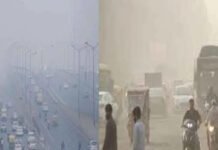
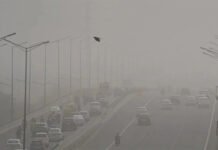
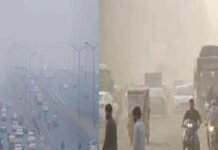
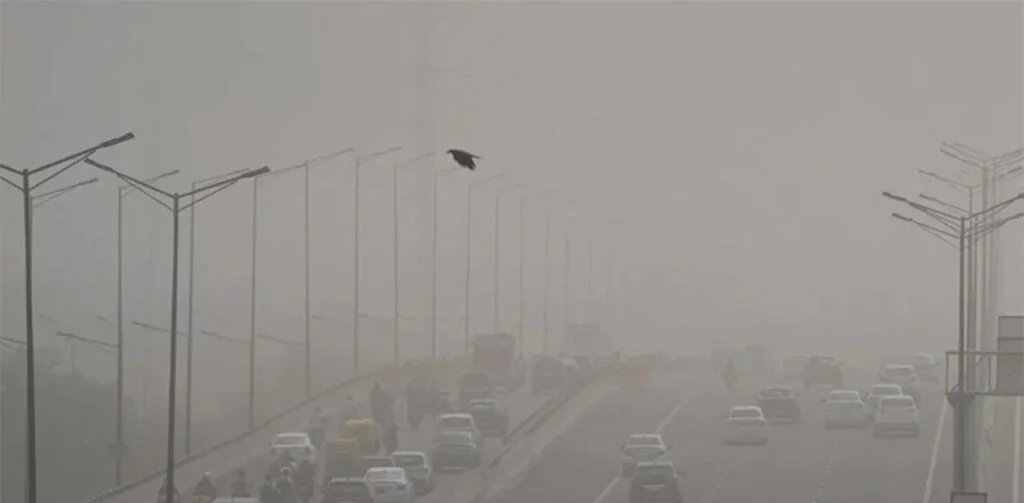
A sharp drop in temperature combined with unfavorable weather conditions has turned the national capital into a gas chamber, pushing Delhi’s air quality into the severe category. Thick layers of fog and smog blanketed the city on Monday, drastically reducing visibility and slowing down traffic across several areas.
The day began with dense mist and fog, while a persistent smog layer remained visible throughout the day. Due to poor dispersion conditions, visibility dropped significantly in many parts of the capital. Delhi recorded an Air Quality Index (AQI) of 401, ranking second among the most polluted cities on Monday. Neighboring Noida reported an AQI of 410, also falling in the severe category.
According to the Decision Support System for Air Quality Management, vehicular emissions accounted for 15.12 percent of pollution in Delhi. Peripheral industrial activities contributed 7.03 percent, residential sources 3.68 percent, construction activities 2.07 percent, and road dust 1.08 percent.
Data from the Central Pollution Control Board (CPCB) showed that winds were blowing from the northwest at a speed of 16 kilometers per hour. Air quality remained in the severe category at 24 monitoring stations, while several other areas recorded very poor levels.
Experts attribute the worsening air quality primarily to weather conditions. Skymet Vice President Mahesh Palawat said falling temperatures have significantly increased pollution levels. He explained that western disturbances are trapping cold air close to the surface, preventing vertical air movement. As a result, pollutants such as vehicle emissions and construction dust accumulate near ground level.
The situation worsens in the absence of rainfall and with slow wind speeds, which prevent pollutants from dispersing, leading to prolonged episodes of severe air pollution.
Across the National Capital Region, Gurugram recorded an AQI of 318, Ghaziabad 393, Greater Noida 356, and Faridabad 253.
Several areas in Delhi reported extremely high pollution levels. Jahangirpuri topped the list with an AQI of 459, followed by Anand Vihar at 455, Nehru Nagar at 439, Punjabi Bagh at 438, Patparganj at 432, Siri Fort at 431, and Chandni Chowk and Mundka at 422 each. Okhla Phase 2 recorded an AQI of 408, ITO 407, and Dwarka Sector 8 stood at 418.
Authorities continue to monitor the situation as residents struggle with health concerns, low visibility, and worsening winter pollution conditions.