New Delhi | November 5, 2025 — Health & Environment Special Report
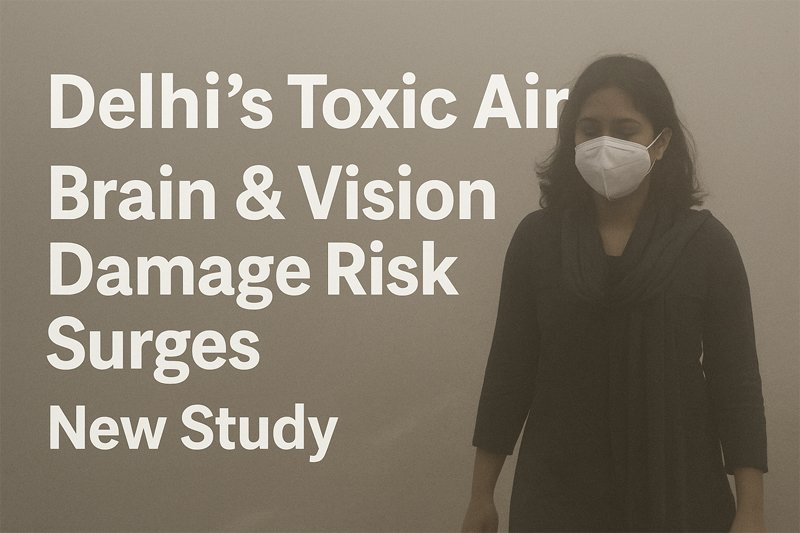
A new multi-institutional study has sounded alarm over the neurological and ocular damage caused by Delhi’s persistent air pollution, linking long-term PM2.5 exposure to irreversible brain disorders, including Alzheimer’s disease and dementia.
The report, conducted jointly by AIIMS, the Indian Institute of Public Health (IIPH), and Lancet Planetary Health collaborators, found that chronic inhalation of fine particulate matter increases the risk of cognitive decline by up to 2.4 times in adults exposed for more than five years.
“PM2.5 penetrates the blood-brain barrier, triggering inflammation and neuronal loss. This is now clinically visible in Delhi’s long-term residents,” said Dr. Sandeep Budhiraja, senior neurologist at Max Healthcare.
🧩 Key Findings: PM2.5’s Neurological Toll
| Health Indicator | Findings (Delhi-NCR) |
|---|---|
| Risk of Alzheimer’s/Dementia | +140% in long-term residents |
| Neurological inflammation markers | 3.2x higher than national average |
| Cognitive impairment (mild to severe) | 21% higher incidence in adults 40–65 |
| Eye-related OPD visits (2023–25) | Doubled; +60% rise in conjunctivitis & corneal irritation |
| PM2.5 Exposure | 10–12x WHO safe limits year-round |
Source: AIIMS–IIPH Joint Research, 2025
🧠 Air and the Aging Brain
Scientists note that ultrafine particles in polluted air — primarily PM2.5 and PM10 — can enter the bloodstream through the olfactory nerve, damaging brain tissue and accelerating amyloid plaque buildup, a key driver of Alzheimer’s disease.
“Air pollution is now a major environmental neurotoxin,” said Dr. Randeep Guleria, AIIMS pulmonologist.
“Its effects extend beyond the lungs — it impacts the brain, heart, and vision.”
👁️ Delhi’s Eye Crisis Deepens
Hospitals across Delhi-NCR report a doubling in outpatient visits (OPDs) for eye-related ailments, including dry eye syndrome, allergic conjunctivitis, and optic nerve strain, particularly among children and senior citizens.
“Continuous exposure to smog particles irritates the cornea and damages tear ducts,” explained Dr. Reena Gupta, ophthalmologist at Safdarjung Hospital.
“We’re seeing children with visual fatigue symptoms typical of industrial exposure zones.”
🏥 Public Health Implications
Doctors warn that the neurological and visual impact of air pollution could become India’s next silent epidemic, rivaling diabetes and hypertension in urban disease burden.
Health authorities have urged air-quality-linked health warnings, neurological screening programs, and research funding for pollution-related cognitive disorders.
🌍 Policy and Prevention
The National Clean Air Programme (NCAP) aims to cut PM2.5 levels by 40% by 2026, but experts say progress remains slow.
They recommend:
Mandatory health alerts on high-AQI days.
Neuro-ophthalmic clinics in NCR hospitals.
Increased green zones and urban air filtration programs.
Federal-level monitoring of cognitive health metrics.
“This is no longer just an environmental issue — it’s a national health emergency,” said Dr. Aruna Sharma, IIPH lead researcher.