Mumbai, India — April 8, 2026
India’s central bank, the Reserve Bank of India, has kept its key policy rate unchanged, signaling stability in borrowing costs and offering continued relief to loan borrowers.
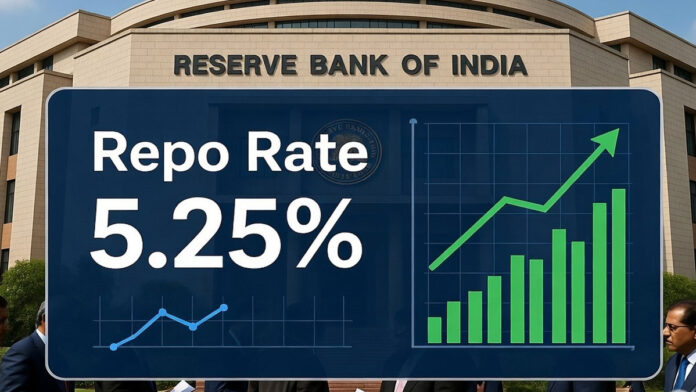
Announcing the outcome of the Monetary Policy Committee (MPC) meeting, RBI Governor Sanjay Malhotra confirmed that the repo rate remains steady at 5.25%, meaning there will be no immediate change in EMIs for home, auto, or personal loans.
MPC Maintains Status Quo Amid Global Uncertainty
The decision was taken unanimously by the MPC, reflecting a cautious yet balanced approach as global economic uncertainties persist.
Governor Malhotra highlighted that ongoing geopolitical tensions and global disruptions continue to pose risks, requiring policymakers to remain vigilant.
At the same time, the RBI maintained a “neutral” policy stance, indicating flexibility to adjust rates depending on evolving economic conditions.
Inflation Remains Under Control
In a positive signal for consumers and businesses, the RBI confirmed that inflation remains below its 4% target level.
Stable inflation provides room for the central bank to hold rates steady while supporting economic growth without triggering price pressures.
Strong Domestic Growth Indicators
Despite global challenges, India’s domestic economy continues to show resilience.
High-frequency indicators—including consumption trends, industrial activity, and services sector performance—suggest that economic momentum remains strong.
Key Highlights of RBI Policy
- Repo Rate: Unchanged at 5.25%
- Policy Stance: Neutral
- Inflation: Below 4% target
- Growth Outlook: Stable with strong domestic indicators
- Global Risks: Elevated due to geopolitical tensions
What It Means for Borrowers and Markets
The decision to hold rates steady ensures:
- No increase in EMIs for existing borrowers
- Stable lending environment for businesses
- Predictability for financial markets
Analysts say the RBI’s approach balances growth and inflation risks while maintaining policy flexibility.
Outlook
With inflation under control and growth indicators holding firm, the RBI appears to be prioritizing stability amid global uncertainty.
Future policy decisions will likely depend on inflation trends, global developments, and domestic economic performance in the coming months.