
New Delhi, India — March 10, 2026
Government Begins Process Toward 8th Pay Commission
The central government has taken an initial step toward forming the 8th Pay Commission, inviting suggestions from employee unions and stakeholders. The development has sparked optimism among millions of central government employees and pensioners expecting a major revision in salaries and benefits.
The move signals that preparations for the next pay revision are underway as the government begins consultations before officially announcing the commission’s chairman and members.
Expected Salary Increase and Fitment Factor
One of the most widely discussed aspects of the upcoming pay revision is the fitment factor, which determines the multiplication used to revise basic salaries.
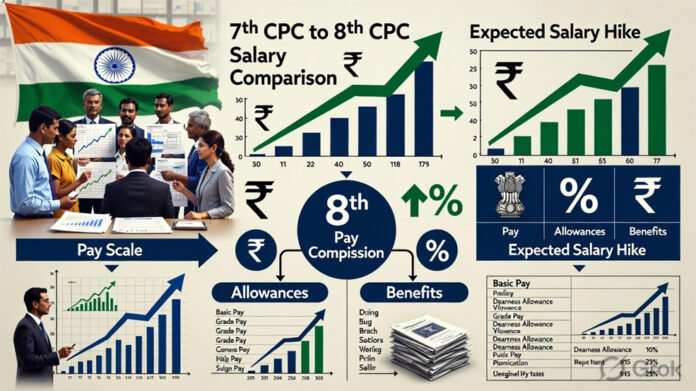
Reports suggest the fitment factor could rise from 2.57 under the 7th Pay Commission to around 3.68 under the proposed 8th Pay Commission.
If implemented, the minimum basic salary for central government employees could increase from ₹18,000 to approximately ₹26,000.
Analysts estimate this could translate into a 44%–50% increase in basic pay for many employees.
When Could the New Pay Commission Be Implemented?
Traditionally, a new pay commission is introduced every 10 years.
Since the 7th Pay Commission came into effect in 2016, the next revision is widely expected to be implemented from January 1, 2026, although the final timeline will depend on the government’s decision.
Benefits for Employees and Pensioners
The proposed changes could bring several financial benefits.
Salary Increase
Current government employees are expected to see a significant rise in their monthly income due to the revised pay structure.
Higher Pension
Retired employees will also benefit, as pensions are calculated based on basic pay. Experts estimate pension payments could rise by ₹8,000 to ₹15,000 per month for many retirees.
Allowances
Allowances such as House Rent Allowance (HRA) and other benefits are linked to basic salary levels and could also increase accordingly.
Additionally, the existing Dearness Allowance (DA) may be merged into the revised basic pay when the new commission takes effect.
Estimated Salary Changes Across Levels
Based on the proposed fitment factor of 3.68, early projections suggest the following possible changes:
| Pay Level | Current Basic Pay (7th CPC) | Estimated Basic Pay (8th CPC) |
|---|---|---|
| Level 1 (Entry Level) | ₹18,000 | Around ₹26,000 |
| Level 5 (Mid-Level) | ₹29,200 | Around ₹42,000+ |
| Level 10 (Senior Level) | ₹56,100 | Around ₹80,000+ |
These figures are indicative and will depend on the final recommendations of the pay commission.
Departments Likely to See Major Impact
While all central government employees would benefit, some sectors could see the most significant impact due to their workforce size.
Indian Railways
With one of the largest employee bases, railway staff including track workers, gangmen, and support staff could see substantial increases in minimum pay and allowances. Running allowances for locomotive pilots and guards may also rise significantly.
Defense Forces
Personnel in the Army, Navy, and Air Force could receive additional benefits such as increases in Military Service Pay (MSP) and improved risk allowances for those posted in challenging locations.
The revision could also affect pensions under the One Rank One Pension (OROP) system.
Postal Department
Employees such as Gramin Dak Sevaks (GDS) and postmen could see improved financial stability due to revised salary structures.
Public Sector Banking and Insurance
Although banking salaries are typically decided through bipartite settlements, they often follow benchmarks set by pay commissions. Employees in public sector insurance companies may also benefit from the revised pay structure.
Demands from Employee Unions
Employee organizations are pushing for additional reforms, including annual salary reviews linked to inflation, rather than waiting for a full decade between pay revisions.
Another key demand involves restructuring the pay matrix system to reduce salary disparities between lower and mid-level employees.
Possible Introduction of Performance-Linked Incentives
Government officials are also considering the introduction of Performance Linked Incentives (PLI) within the pay framework.
Under such a system, employees demonstrating stronger performance could receive additional increments beyond the standard salary increase.
Next Steps
Once formally constituted, the 8th Pay Commission is expected to submit its recommendations within 12–18 months.
After cabinet approval, the revised pay structure could be implemented along with salary arrears for employees.
For millions of government employees and pensioners, the upcoming commission could mark one of the most significant financial revisions in a decade.