
New Delhi, India — March 3, 2026
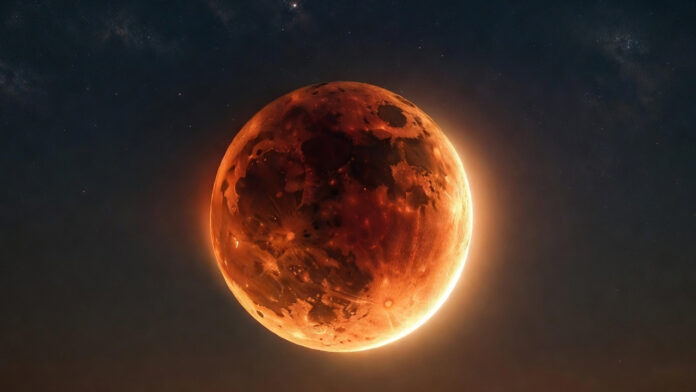
The most significant total lunar eclipse of 2026 will light up the skies on Tuesday, offering millions a rare celestial display as the Moon turns deep red during totality.
The eclipse begins at 3:20 PM IST and will continue until 6:48 PM IST, with the total phase peaking between 4:34 PM and 5:33 PM IST. Astronomers describe this event as one of the most visually striking lunar eclipses of the year.
What Is a Total Lunar Eclipse?
A lunar eclipse occurs when the Earth moves directly between the Sun and the Moon, casting its shadow on the lunar surface. This phenomenon can only happen during a Full Moon, when the Sun, Earth, and Moon align nearly in a straight line.
When the Moon fully enters Earth’s darkest shadow region, known as the umbra, the event is classified as a total lunar eclipse.
Why Will the Moon Turn Red?
The Moon’s dramatic red color during totality is the result of atmospheric filtering.
As sunlight passes through Earth’s atmosphere, shorter blue and violet wavelengths scatter more easily, while longer red and orange wavelengths continue through. This red light bends around the Earth and illuminates the Moon, giving it a coppery or blood-red appearance.
The same scientific principle explains why sunrises and sunsets often appear red or orange.
Where Will It Be Visible in India?
Across most parts of India, the eclipse will be visible during moonrise in its final stages.
In northeastern India and the Andaman and Nicobar Islands, observers may catch the last glimpse of the total phase more clearly, as the Moon rises slightly earlier there.
In southern cities such as Chennai and Kanyakumari, the eclipse may remain visible for approximately 30 minutes after moonrise, weather permitting.
Global Visibility
Astronomers estimate that nearly 40% of the world’s population may witness at least a portion of this total lunar eclipse.
The eclipse will be visible in:
Large parts of Asia
Australia
Portions of Africa
Some regions of Europe
Parts of the Americas
Visibility depends on local timing and weather conditions.
A Rare Celestial Event
Astronomy experts note that a similar alignment will not occur again until 2028, making this eclipse particularly noteworthy for skywatchers.
Unlike solar eclipses, lunar eclipses are completely safe to observe with the naked eye. No special protective equipment is required.