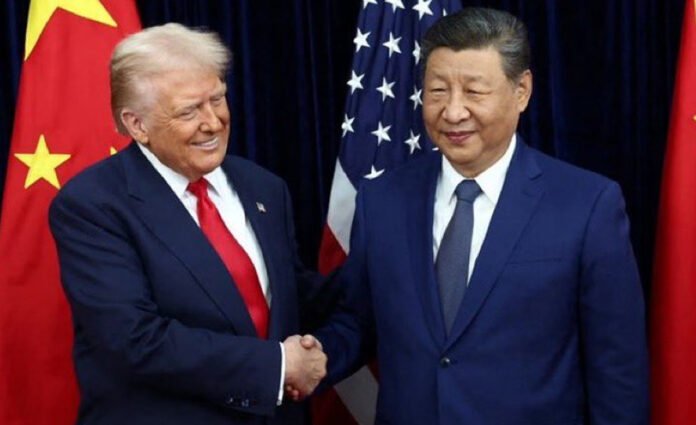
Washington, D.C. : In a major reversal of U.S. technology export policy, President Donald Trump announced on December 9, 2025, that the United States will allow Nvidia to resume shipments of its cutting-edge H200 AI chips to China. The move marks a significant easing of the export restrictions imposed in 2024, which blocked advanced AI chips over concerns that they could strengthen China’s military capabilities.
The decision was finalized during Trump’s high-profile Beijing summit with Chinese President Xi Jinping, which sought to recalibrate the two countries’ strained economic ties. Trump framed the move as part of a broader strategy to reduce protectionism and address the U.S.–China trade imbalance, noting that China recorded a $1 trillion trade surplus in 2025.
Nvidia Celebrates “Win for Innovation”
Nvidia CEO Jensen Huang welcomed the announcement, calling it a “win for innovation and global progress.” The company expects the restored market access to generate $5 billion in revenue during Q1 2026, as Chinese cloud providers and research institutes rush to secure H200 units for AI training.
China’s AI sector has grown rapidly, underscored by DeepSeek’s release of advanced models that have begun challenging OpenAI in performance benchmarks—adding urgency to China’s need for high-end compute chips.
National Security Concerns Remain
Not everyone is pleased. U.S. Senator Marco Rubio criticized the decision, warning that easing chip restrictions could enable Huawei and other Chinese firms to advance dual-use technologies with military applications.
To address security concerns, the administration has attached strict conditions:
-
Export licenses waived only for non-military applications
-
A 90-day national security review clause allowing reinstatement of restrictions
-
End-use reporting requirements for Chinese buyers
Officials claim the framework balances innovation with national security safeguards.
Impact on Global Supply Chains — and India
Industry analysts say the policy shift could stabilize global semiconductor supply chains, easing pressure on AI hardware markets that have experienced shortages since 2024.
The relaxation is also expected to benefit India’s emerging AI sector, including new university-industry partnerships such as IIT Bombay’s AI venture, which relies on global GPU availability for model development and training.
A Sign of Broader US–China Thaw
The export approval is being viewed as a symbolic breakthrough in U.S.–China relations, complementing new trade dialogue channels opened during the Beijing summit. Both sides are seeking to contain economic escalations while preserving technological advantages.
However, geopolitical analysts warn that the détente may be temporary, especially as Washington eyes stricter oversight of AI-enabled defense technologies.
What Comes Next
With peace talks in Europe at an impasse and AI competition accelerating in Asia, the decision is likely to reverberate across multiple sectors. The Commerce Department is expected to release detailed compliance guidelines within 30 days.
For now, the return of Nvidia’s H200 to the Chinese market signals a pragmatic trade recalibration—one that may redefine global AI dynamics heading into 2026.