China’s Bold Move into Global AI Leadership
Beijing, November 5, 2025:
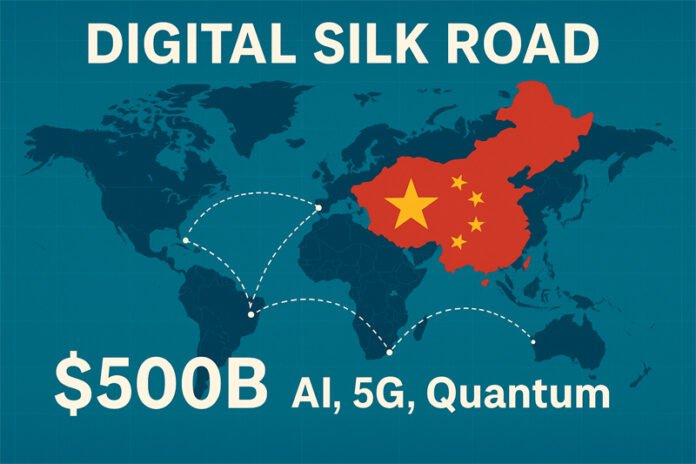
China has officially launched a $500 billion AI-driven “Digital Silk Road” under its Belt and Road Initiative (BRI), marking one of the world’s largest technology investments aimed at reshaping the global digital economy. The new strategy aims to build AI, 5G, quantum computing, and cloud infrastructure across Asia, Africa, and the Middle East — directly challenging U.S. technology dominance.
What Is the Digital Silk Road?
The Digital Silk Road (DSR) is an expansion of China’s original Belt and Road Initiative, focusing on digital connectivity and AI innovation instead of physical infrastructure.
According to the Ministry of Industry and Information Technology (MIIT), the DSR’s goal is to “build a shared digital future” by developing AI-powered communication systems, data centers, and smart cities.
“The future of global growth lies in intelligent connectivity,” said Wang Wentao, China’s Minister of Commerce. “This initiative will empower developing countries through shared innovation and technology sovereignty.”
$500 Billion Investment Across Asia and Africa
China’s Digital Silk Road will fund:
$200 billion for AI and cloud data hubs in Asia.
$150 billion for 5G networks and digital communication infrastructure.
$100 billion for quantum computing and satellite internet.
$50 billion for AI training centers and smart city projects in Africa.
So far, over 20 nations have joined the initiative, including Indonesia, Kenya, Saudi Arabia, Egypt, Pakistan, and Nigeria.
Leading Chinese tech giants — Huawei, ZTE, Alibaba Cloud, and Baidu AI — are at the forefront of the expansion, setting up research partnerships and digital innovation hubs across these regions.
China’s Strategy to Counter U.S. Tech Influence
Analysts describe the move as China’s answer to Washington’s CHIPS Act and Indo-Pacific Economic Framework (IPEF). While the United States focuses on semiconductor alliances, China is strengthening its AI infrastructure and data control globally.
“The Digital Silk Road is more than technology—it’s a soft power strategy,” said Dr. Li Cheng, a researcher at the Brookings-Tsinghua Center. “By controlling AI infrastructure across continents, China positions itself as the core of the future digital economy.”
Despite U.S. warnings about data privacy and surveillance risks, several nations view the Chinese model as cost-effective and transformative for their local economies.
The Quantum Edge: China’s Next Frontier
A major highlight of the DSR is the Quantum Communication Network Initiative, with plans to launch quantum encryption satellites and secure cloud platforms across Asia and Africa by 2030.
This would give Beijing a technological advantage in cybersecurity and data transmission, outpacing traditional Western networks in both speed and security.
Implications for the Global Tech Landscape
Experts predict that China’s Digital Silk Road could reshape global internet governance and AI ethics frameworks, as more developing countries integrate Chinese standards and digital norms.
If successful, the project could generate trillions in digital trade and strengthen Beijing’s influence over AI-driven economies for decades.
Conclusion: The Dawn of a New Digital Order
With the launch of the Digital Silk Road, China is taking a definitive step toward building a global AI empire.
As 5G, AI, and quantum technologies merge under this trillion-yuan vision, Beijing is not just exporting technology — it is exporting the future of connectivity.