Stockholm / Global, October 13–14, 2025
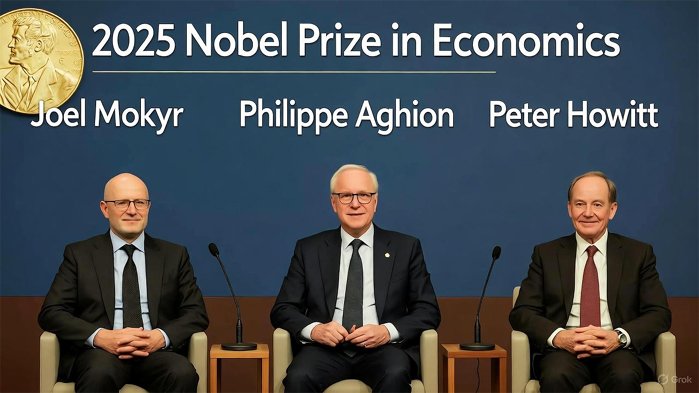
In a milestone announcement that captures the importance of innovation in modern economies, the 2025 Nobel Prize in Economic Sciences has been awarded to Joel Mokyr, Philippe Aghion, and Peter Howitt for their pioneering research on how technological change and creative destruction drive sustained economic growth. Financial Times+2The Guardian+2
The Royal Swedish Academy of Sciences stated that their work helps explain why some societies prosper, while others stagnate — a question central to the economics of our age. The Guardian+2Financial Times+2
🧠 What Won Them the Prize
Joel Mokyr receives half of the prize for his deep historical and theoretical insights into how scientific knowledge, culture, and institutions set the stage for long-run growth. Financial Times+2Le Monde.fr+2
Philippe Aghion and Peter Howitt share the other half for their joint work on the “creative destruction” model, showing how innovation and competition continuously displace old technologies to spur productivity gains. Financial Times+3The Guardian+3Financial Times+3
The award committee emphasized that their combined contributions anchor endogenous growth theory — growth that arises from forces within economies (like innovation) rather than external forces. Financial Times+2Le Monde.fr+2
“We must uphold the mechanisms that underlie creative destruction, so that we do not fall back into stagnation,” said John Hassler, chair of the Nobel committee. The Guardian+1
In his acceptance remarks, Aghion cautioned against rising protectionism and the dominance of “superstar” tech firms that could stifle entry of new innovators. He also praised AI’s growth potential, but warned governments must regulate to maintain healthy competition. Financial Times+3The Guardian+3Le Monde.fr+3
🌍 Why It Matters Now
This is not just an academic prize — the timing underscores global concerns over slowing productivity, inequality, and the role of technology in shaping future growth.
The laureates’ work offers a blueprint for policymakers seeking to balance innovation incentives, regulation, and inclusive growth. As economies grapple with automation, digital platforms, and shifting labor markets, their models help explain how new firms and technologies can displace incumbents — and when that process can go awry.
For instance, Aghion’s warnings on tech monopolies are particularly resonant in an era where a few companies dominate digital ecosystems. The idea of creative destruction isn’t just theoretical — it’s unfolding daily in sectors disrupted by AI, clean energy, and biotech.
“Innovation is not just an engine; it’s also a discipline. We must protect entry, nurture competition, and support those displaced,” many observers paraphrase from the laureates’ body of work.
🧩 Background of the Laureates
Joel Mokyr (Northwestern University) has long explored how culture, knowledge, and institutions shaped the Industrial Revolution and the sustained growth that followed. Financial Times+2Le Monde.fr+2
Philippe Aghion (Collège de France / LSE / INSEAD) is known for his work linking innovation to economic policies and institutions. Le Monde.fr+2AP News+2
Peter Howitt (Brown University) is a leading theorist in macroeconomics who, alongside Aghion, advanced the formal modeling of growth driven by innovation. Wikipedia+2Le Monde.fr+2
In interviews, Aghion spoke about his upbringing in a creative environment — his mother, Gaby Aghion, founded the fashion house Chloé — as helping shape his worldview about innovation and freedom. AP News
🔍 Relevance for India & Developing Economies
The laureates’ frameworks carry special relevance for countries like India aiming to accelerate growth without losing social equity.
Policies that foster entrepreneurship, R&D investment, and ease of doing business align closely with these theories.
Ensuring fair competition and preventing market concentration — especially in technology and telecom — echoes Aghion’s cautions about “superstar firms.”
Supporting the transition of labor displaced by innovation through retraining and social safety nets is critical in growing economies.
An Indian economist or policymaker quoting or applying these models in debates over “Make in India,” digital markets, or the future of work would therefore resonate strongly with global thought.
✅ Final Thoughts
The 2025 Nobel Prize in Economics celebrates more than academic achievement — it honors a vision of growth anchored in creativity, competition, and institutions. As nations around the world wrestle with technological disruption, inequality, and volatility, the insights of Mokyr, Aghion, and Howitt will likely shape economic policy and discourse for years to come.