
Washington, D.C. | June 28, 2026
India-US Technology Partnership is entering a transformative phase as the world’s two largest democracies intensify cooperation in semiconductor manufacturing, artificial intelligence (AI), quantum technology, critical minerals, and resilient technology supply chains. What began as a strategic dialogue has rapidly evolved into a practical roadmap focused on innovation, industrial resilience, and long-term economic security.
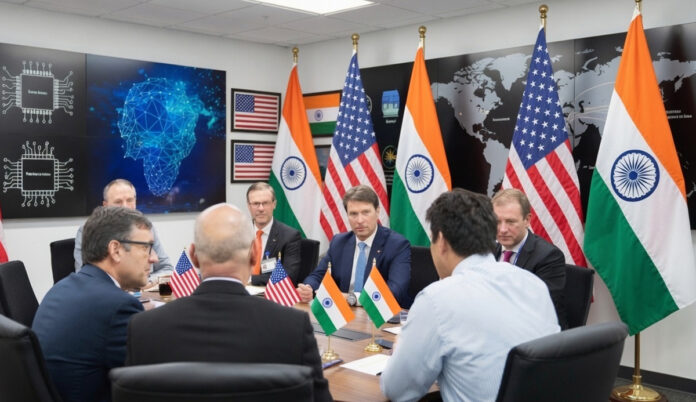
Senior officials from both countries emphasized during a high-level strategic roundtable in Washington that bilateral cooperation is moving beyond policy discussions toward concrete projects capable of reshaping global technology ecosystems. As geopolitical uncertainties continue to influence international supply chains, India and the United States are positioning themselves as trusted partners committed to building secure, transparent, and diversified technology networks.
The discussions highlighted a shared vision of strengthening advanced manufacturing capabilities, accelerating research and development, promoting innovation, and ensuring that critical technologies remain supported by dependable supply chains. Government representatives, industry leaders, diplomats, and policy experts agreed that the next decade will be defined by collaboration in emerging technologies that power the global digital economy.
Strategic Partnership Moves Beyond Policy Into Action
The roundtable, organized in Washington by the US-India Strategic Partnership Forum (USISPF) in collaboration with the Embassy of India and the Silverado Policy Accelerator, brought together senior policymakers, business executives, technology leaders, and strategic experts from both countries.
Participants focused on expanding cooperation in several sectors that are expected to shape the global economy over the coming decades, including:
- Semiconductor manufacturing
- Artificial Intelligence
- Quantum technologies
- Critical minerals
- Advanced energy systems
- Trusted global technology supply chains
Unlike earlier discussions centered primarily on strategic intent, this year’s dialogue emphasized implementation. Officials repeatedly noted that bilateral cooperation is increasingly producing tangible initiatives, investments, and industrial partnerships designed to reduce supply-chain vulnerabilities while accelerating technological innovation.
Vinay Kwatra: India and the US Are Natural Technology Partners
Addressing the gathering, India’s Ambassador to the United States, Vinay Kwatra, described India and America as complementary technology partners whose respective strengths create exceptional opportunities for collaboration.
He observed that both countries have significant opportunities to work together across the entire technology value chain—from semiconductor fabrication and advanced chip design to neural networks, artificial intelligence, and next-generation computing.
According to Kwatra, India’s mission-driven approach toward emerging technologies aligns naturally with America’s world-leading innovation ecosystem. This combination, he said, creates an environment capable of delivering long-term technological breakthroughs while strengthening economic competitiveness for both nations.
He stressed that trusted partnerships are becoming increasingly important as countries seek reliable alternatives to fragile global supply chains disrupted by geopolitical tensions and economic uncertainty.
Building Trusted Technology Supply Chains
One of the central themes of the discussions was the importance of developing trusted technology supply chains capable of supporting the world’s rapidly growing digital economy.
Participants agreed that advanced technologies depend not only on innovation but also on secure access to manufacturing infrastructure, critical raw materials, advanced computing resources, and highly skilled talent.
India and the United States aim to collaborate across every stage of this ecosystem, including:
- Semiconductor fabrication
- Chip packaging and testing
- Research partnerships
- Artificial intelligence infrastructure
- Data processing capabilities
- Cloud computing
- Critical mineral sourcing
- Secure logistics networks
Officials noted that diversified supply chains reduce dependence on single geographic regions while improving resilience against disruptions caused by geopolitical conflicts, natural disasters, or trade restrictions.
This strategy has become increasingly important as governments worldwide seek to strengthen economic security while maintaining technological leadership.
Semiconductors Become the Foundation of Future Growth
Semiconductors remain at the heart of the India-US technology agenda.
Often described as the “brains” behind modern electronics, semiconductor chips power everything from smartphones and electric vehicles to artificial intelligence systems, defense equipment, healthcare devices, industrial automation, and cloud computing infrastructure.
Recognizing their strategic importance, both governments have significantly expanded policy initiatives designed to increase semiconductor manufacturing capacity.
India’s Semiconductor Mission has already attracted major global investment commitments aimed at establishing fabrication plants, assembly facilities, testing infrastructure, and design centers across the country.
Meanwhile, the United States continues to strengthen domestic chip production while encouraging trusted international partnerships with countries capable of supporting resilient manufacturing ecosystems.
Officials believe that combining American technological leadership with India’s rapidly expanding manufacturing capabilities and engineering talent creates significant long-term opportunities for both economies.
Artificial Intelligence Emerges as the Next Strategic Frontier
Artificial intelligence received equal attention during the discussions, reflecting its growing influence across virtually every sector of the global economy.
From healthcare diagnostics and financial services to manufacturing automation, cybersecurity, education, logistics, agriculture, and scientific research, AI is rapidly transforming industries worldwide.
Officials emphasized that India possesses several competitive advantages in AI development, including:
- A vast digital economy
- Highly skilled software professionals
- Expanding AI research capabilities
- Large-scale digital public infrastructure
- Growing startup ecosystem
The United States, meanwhile, continues to lead global innovation in advanced AI models, semiconductor design, venture capital investment, and frontier research.
By combining these complementary strengths, policymakers believe both nations can accelerate responsible AI innovation while promoting secure, transparent, and trustworthy AI development.
The discussions also explored opportunities for greater collaboration in AI governance, research partnerships, talent development, and industry-led innovation.
Quantum Technology Shapes the Next Computing Revolution
Another major focus was quantum technology—an emerging field expected to redefine computing, communications, cybersecurity, pharmaceutical research, and advanced scientific discovery.
Experts believe quantum computing could eventually solve complex problems that remain beyond the capabilities of today’s most powerful supercomputers.
India and the United States are expanding research cooperation to ensure they remain global leaders in quantum science and engineering.
Officials noted that investments made today in quantum research, workforce development, and industrial collaboration will likely determine technological leadership for decades to come.
Critical Minerals Become the Backbone of the India-US Technology Partnership
Beyond artificial intelligence and semiconductors, the India-US Technology Partnership is increasingly centered on securing reliable access to critical minerals—the raw materials that power the world’s most advanced technologies. From electric vehicles and renewable energy systems to defense equipment and semiconductor manufacturing, these minerals have become indispensable to the modern economy.
Officials at the Washington roundtable emphasized that future technological leadership will depend not only on innovation but also on resilient access to essential resources such as lithium, cobalt, nickel, graphite, and rare earth elements. These minerals are fundamental for producing batteries, advanced electronics, clean energy technologies, and sophisticated defense platforms.
As global demand continues to surge, both India and the United States are working to diversify supply sources, reduce dependence on concentrated markets, and establish trusted partnerships capable of ensuring long-term resource security.
The discussions highlighted that closer cooperation in exploration, processing, recycling, and responsible sourcing of critical minerals could significantly strengthen both countries’ industrial competitiveness while supporting global supply chain resilience.
S. Krishnan: India Is Emerging as a Trusted Technology Manufacturing Hub
Speaking during the roundtable, S. Krishnan, Secretary in India’s Ministry of Electronics and Information Technology (MeitY), said India has rapidly evolved into one of the world’s most reliable technology partners.
He noted that the country’s electronics manufacturing ecosystem has expanded at an unprecedented pace over the past decade, supported by policy reforms, infrastructure development, skilled human resources, and increasing investor confidence.
According to Krishnan, India is now moving beyond electronics assembly toward higher-value manufacturing, with semiconductor fabrication becoming a practical reality rather than a long-term aspiration.
He explained that the next phase of India’s Semiconductor Mission will focus on expanding fabrication capabilities, strengthening component manufacturing, enhancing research capacity, and building a comprehensive semiconductor ecosystem capable of serving both domestic and global markets.
The government’s long-term objective is to position India among the world’s leading semiconductor manufacturing destinations while supporting innovation across the broader digital economy.
India’s Digital Public Infrastructure Offers a Competitive Advantage
Krishnan also highlighted India’s globally recognized Digital Public Infrastructure (DPI) as a major strategic asset supporting innovation across artificial intelligence, digital governance, financial inclusion, healthcare, education, and entrepreneurship.
India’s rapidly expanding digital ecosystem—including secure digital identity systems, real-time payment platforms, cloud-based public services, and large-scale digital connectivity—creates a unique environment for developing next-generation AI solutions.
Combined with one of the world’s largest pools of software engineers and technology professionals, these capabilities position India as an increasingly attractive destination for collaborative research and innovation.
Officials noted that solutions developed through India-US collaboration could benefit not only the two countries but also emerging economies seeking affordable, scalable, and secure digital technologies.
Private Industry Will Drive the Next Phase of Growth
Government leaders repeatedly stressed that while public policy creates the foundation for strategic cooperation, the private sector will determine the ultimate success of the India-US Technology Partnership.
K. Nagaraj Naidu, Additional Secretary (Americas) in India’s Ministry of External Affairs, said bilateral relations have evolved into a comprehensive strategic partnership designed to meet the technological and economic demands of the twenty-first century.
He emphasized that initiatives involving artificial intelligence, quantum technology, advanced energy systems, semiconductor manufacturing, critical minerals, and trusted supply chains are now moving beyond diplomatic discussions toward implementation.
According to Naidu, businesses, investors, research institutions, and technology companies will play the leading role in translating government frameworks into commercially successful projects.
Private-sector collaboration is expected to accelerate:
- Joint research and development
- Cross-border investments
- Advanced manufacturing
- Technology commercialization
- Startup partnerships
- Innovation ecosystems
- Workforce development
Such cooperation will enable faster deployment of emerging technologies while creating new employment opportunities and expanding bilateral trade.
USISPF Calls for Deeper Strategic Collaboration
Mukesh Aghi, President and Chief Executive Officer of the US-India Strategic Partnership Forum (USISPF), described semiconductors and critical minerals as two of the defining strategic assets of the twenty-first-century global economy.
He observed that governments can establish regulatory frameworks and policy support, but innovation, investment, manufacturing, and commercialization ultimately depend on industry leadership.
According to Aghi, India and the United States are uniquely positioned to build one of the world’s most trusted technology partnerships because each country contributes complementary strengths.
The United States offers:
- Global innovation leadership
- Advanced semiconductor research
- World-class universities
- Venture capital ecosystems
- Frontier AI development
India contributes:
- Highly skilled engineering talent
- Large-scale manufacturing potential
- Digital infrastructure
- Competitive production costs
- Expanding domestic technology market
By integrating these strengths, both countries can develop resilient supply chains capable of supporting long-term global economic growth.
Technology Cooperation Expands Beyond Traditional Trade
Experts participating in the discussions noted that bilateral relations are no longer driven solely by trade volumes.
Instead, technology cooperation has emerged as the defining pillar of the India-US strategic relationship.
Areas of collaboration now include:
- Artificial Intelligence
- Semiconductor fabrication
- Chip design
- Quantum computing
- Cybersecurity
- Advanced telecommunications
- Critical minerals
- Renewable energy technologies
- Space technology
- Biotechnology
- Defense innovation
This broadening agenda reflects the growing importance of technological competitiveness in national security, economic resilience, and geopolitical influence.
Resilient Supply Chains Gain Strategic Importance
The COVID-19 pandemic, geopolitical conflicts, and disruptions in global manufacturing exposed significant vulnerabilities within international supply chains.
As a result, governments worldwide have intensified efforts to diversify production networks and reduce dependence on single-country manufacturing hubs.
Officials said India and the United States share a common objective of developing secure, transparent, and diversified supply chains capable of supporting critical industries without major disruptions.
Trusted supply chains are expected to become particularly important for:
- Semiconductor manufacturing
- AI infrastructure
- Electric vehicles
- Renewable energy
- Defense systems
- Medical technologies
- Telecommunications equipment
Strengthening these sectors through bilateral cooperation will improve economic resilience while supporting sustainable industrial growth.
US and Indian Officials Highlight Shared Vision for the Next Technology Revolution
The roundtable also featured senior representatives from the U.S. government, including Bill Guidera, Deputy Under Secretary for Innovation and Engagement at the U.S. Department of Commerce, and Christopher Saldaña, Deputy Assistant Secretary in the Office of Critical Minerals, Materials and Manufacturing at the U.S. Department of Energy. Their participation underscored Washington’s continued commitment to expanding technology and industrial cooperation with India.
Officials from both governments agreed that emerging technologies are becoming central to economic growth, national security, and long-term global competitiveness. As countries race to strengthen their positions in advanced manufacturing and digital innovation, India and the United States are seeking to build a partnership based on transparency, trust, resilience, and shared democratic values.
The discussions reflected a common understanding that collaboration in strategic sectors such as semiconductors, artificial intelligence, quantum computing, advanced energy systems, and critical minerals will shape the future global economy.
Why the India-US Technology Partnership Matters
The importance of the India-US Technology Partnership extends far beyond bilateral trade. Experts believe the collaboration has the potential to reshape global technology supply chains and reduce dependence on concentrated manufacturing hubs.
Several factors are driving this partnership:
Growing Demand for Semiconductors
The rapid expansion of artificial intelligence, cloud computing, electric vehicles, consumer electronics, and advanced defense systems has created unprecedented demand for semiconductor chips. Both countries are investing heavily in manufacturing capacity to meet future requirements.
Artificial Intelligence Leadership
AI is expected to become one of the world’s most transformative technologies. Collaboration between India’s engineering talent and America’s research ecosystem could accelerate innovation in healthcare, finance, manufacturing, agriculture, education, cybersecurity, and public services.
Critical Minerals Security
Reliable access to lithium, cobalt, graphite, nickel, and rare earth elements has become a strategic priority. These resources are essential for clean energy technologies, batteries, advanced electronics, and defense manufacturing.
Quantum Computing
Quantum technologies promise breakthroughs in scientific research, cryptography, pharmaceutical discovery, logistics optimization, and climate modeling. Early collaboration could provide long-term strategic advantages for both nations.
Trusted Global Supply Chains
Recent global disruptions highlighted the risks associated with concentrated manufacturing networks. India and the United States are working together to establish diversified, secure, and resilient supply chains capable of supporting future technological growth.
India’s Expanding Role in the Global Technology Economy
India has emerged as one of the fastest-growing technology ecosystems in the world. Government initiatives promoting electronics manufacturing, semiconductor production, startup innovation, digital infrastructure, and advanced research have significantly strengthened the country’s position in global technology value chains.
The expansion of domestic manufacturing capabilities, combined with a large pool of highly skilled engineers and software professionals, has made India an increasingly attractive destination for international investment.
Industry analysts believe India’s advantages include:
- One of the world’s largest engineering workforces
- A rapidly growing startup ecosystem
- Strong digital public infrastructure
- Competitive manufacturing costs
- Expanding semiconductor ecosystem
- Government support through mission-driven initiatives
- Increasing global investor confidence
These strengths complement America’s leadership in frontier research, venture capital, advanced manufacturing, and innovation, creating opportunities for deeper collaboration.
Industry Expected to Lead the Next Phase
A recurring theme throughout the Washington discussions was that government policy alone cannot deliver technological transformation. While policymakers can establish strategic frameworks, the private sector will ultimately determine the pace and scale of implementation.
Technology companies, semiconductor manufacturers, research institutions, venture capital firms, universities, and startup ecosystems are expected to play a central role in advancing bilateral cooperation.
Future collaboration is likely to focus on:
- Joint semiconductor investments
- AI research partnerships
- Quantum technology commercialization
- Supply-chain resilience initiatives
- Critical mineral processing
- Workforce development and skills training
- Startup collaboration and innovation
- Cross-border manufacturing projects
Such initiatives could generate new business opportunities, create high-skilled employment, and strengthen economic ties between the two countries.
A Strategic Partnership Built for the Future
The Washington roundtable reinforced that India and the United States are moving toward a more comprehensive technology partnership that extends beyond traditional diplomacy. Rather than focusing solely on trade or investment, both governments are working to build an integrated innovation ecosystem capable of supporting long-term economic growth.
As emerging technologies continue to reshape industries worldwide, cooperation in semiconductors, artificial intelligence, quantum computing, and critical minerals is expected to become even more significant. By combining complementary strengths in innovation, manufacturing, research, and talent, the two countries aim to establish trusted technology supply chains that are secure, resilient, and globally competitive.
For India, the collaboration supports its ambition to become a global hub for advanced manufacturing and digital innovation. For the United States, it strengthens partnerships with a trusted democratic ally capable of contributing to diversified and resilient technology ecosystems.
The outcomes of the Washington discussions indicate that the India-US Technology Partnership is entering a new phase—one defined not only by strategic intent but by practical cooperation, industrial investment, and shared leadership in the technologies that will shape the decades ahead.
Key Takeaways
- India and the United States are deepening cooperation in semiconductors, AI, quantum technology, and critical minerals.
- Officials said the partnership is moving from policy discussions to real-world projects.
- India aims to become a trusted global semiconductor and technology manufacturing hub.
- Both countries are working to build secure and resilient technology supply chains.
- Private industry is expected to play a leading role in driving innovation and investment.
- The partnership is designed to strengthen long-term economic growth, technological leadership, and global supply-chain resilience.











Comments are closed.