
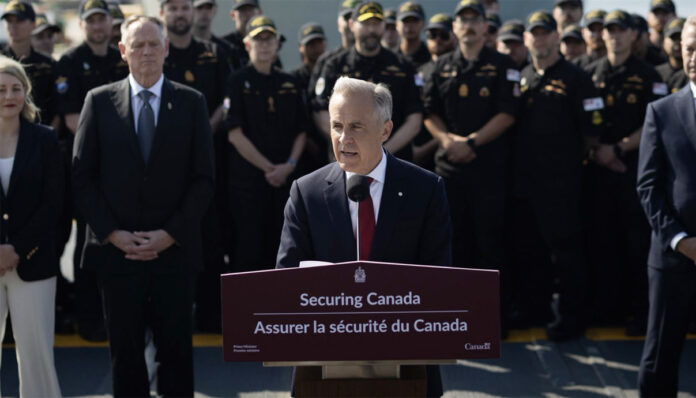
Ottawa, Canada | July 7, 2026
Canada Middle Powers Alliance: Why Mark Carney Wants a New Global Coalition and Why Jamie Dimon Disagrees
Canada Middle Powers Alliance has emerged as one of the most debated ideas in international politics after Canadian Prime Minister Mark Carney proposed stronger cooperation among middle-power nations to navigate an increasingly polarized global economy. The proposal aims to help countries that are neither superpowers nor small economies strengthen their collective influence in areas such as trade, artificial intelligence, critical minerals, supply chains, and security.
However, the idea has drawn sharp criticism from Jamie Dimon, CEO of JPMorgan Chase, who argues that political alliances alone do not create economic strength. According to Dimon, long-term competitiveness depends on policies that encourage investment, innovation, and business growth rather than simply forming new international blocs.
What Is Mark Carney’s Middle Powers Alliance Proposal?
Prime Minister Mark Carney first outlined the concept during discussions at the World Economic Forum in Davos earlier this year.
Saudi Arabia Oil Price Cut Stuns Global Markets; Here’s How India Could Benefit from Cheaper Crude
Carney argued that the international order is undergoing significant change as geopolitical tensions, tariffs, supply chain disruptions, and economic rivalry between major powers reshape global trade.
His proposal calls for greater collaboration among middle-power countries—nations with substantial economic and diplomatic influence but without the geopolitical dominance of superpowers such as the United States or China.
The proposed cooperation would focus on:
- Expanding international trade.
- Developing artificial intelligence partnerships.
- Securing critical mineral supply chains.
- Strengthening economic resilience.
- Enhancing security cooperation.
- Reducing dependence on any single major power.
Carney believes such cooperation could give middle-income and advanced economies a stronger voice in shaping global economic and political decisions.
Why Does Canada Want This Alliance?
Canada’s proposal reflects growing concerns over increasing geopolitical fragmentation.
As competition intensifies between major global powers, many countries face greater exposure to tariffs, supply chain disruptions, trade restrictions, and geopolitical uncertainty.
According to Carney’s vision, closer cooperation among like-minded countries could:
- Improve supply chain resilience.
- Diversify trade partnerships.
- Reduce vulnerability to economic pressure from larger nations.
- Create a more balanced international trading system.
- Strengthen collective bargaining power in global institutions.
The proposal aligns with Canada’s broader strategy of expanding economic partnerships beyond its traditional markets while promoting rules-based international cooperation.
Jamie Dimon Questions the Strategy
Jamie Dimon has challenged the practical effectiveness of Carney’s proposal.
Speaking about global competitiveness, the JPMorgan CEO argued that forming alliances alone is not enough to create economic strength.
Dimon pointed to Europe as an example, noting that despite being one of the world’s largest political and economic groupings, it has struggled to maintain competitiveness relative to the United States.
According to Dimon, Europe’s economy was once approximately 90% the size of the U.S. economy, but today it has fallen to around 70%, illustrating that political integration does not automatically translate into stronger economic performance.
Dimon Says Investment Climate Matters More
Dimon emphasized that sustainable economic success depends on creating an environment where businesses and investors can thrive.
He argued that governments should prioritize:
- Competitive tax policies.
- Investment-friendly regulations.
- Efficient capital markets.
- Support for innovation.
- Strong private-sector growth.
According to Dimon, these factors have contributed to the United States maintaining one of the world’s largest and most dynamic capital markets.
He suggested that Europe should focus less on creating new political frameworks and more on deepening its single market, encouraging open trade in services, and improving its overall business environment.
Economic Policy vs. Political Cooperation
The debate highlights two different approaches to strengthening national and regional influence.
Carney’s approach emphasizes:
- International cooperation.
- Shared economic resilience.
- Diversified supply chains.
- Collective strategic planning.
Dimon’s approach prioritizes:
- Domestic economic reforms.
- Private investment.
- Competitive markets.
- Regulatory efficiency.
- Innovation-led growth.
While both perspectives recognize the challenges posed by an evolving global economy, they differ on the most effective path toward long-term competitiveness.
What Did Dimon Say About the United States and China?
Jamie Dimon also reiterated that the United States remains one of the world’s most attractive destinations for investment, citing its strong financial markets and business environment.
At the same time, he acknowledged that China has recently demonstrated greater stability in its international relationships, a development closely watched by multinational companies and global investors.
Dimon noted that China’s influence in global trade continues to grow, even as countries seek to diversify supply chains and reduce strategic dependencies.
This evolving geopolitical landscape has prompted many governments to strengthen commercial ties with China while maintaining relationships with Western economies.
Why the Debate Matters
The discussion surrounding Canada’s proposal reflects broader questions about how countries should respond to an increasingly fragmented global economy.
Key challenges include:
- Rising protectionism.
- Trade disputes.
- Supply chain disruptions.
- Technological competition.
- Critical mineral security.
- Artificial intelligence governance.
For many middle-power countries, balancing economic growth with geopolitical stability has become an increasingly complex policy objective.
Whether international alliances or domestic economic reforms prove more effective may ultimately depend on how governments adapt to rapidly changing global conditions.
Global Attention on Canada’s Proposal
Although Carney’s proposal has sparked significant debate, it has also highlighted growing interest in alternative models of international cooperation beyond traditional alliances.
Supporters argue that stronger collaboration among middle-power nations could increase resilience against geopolitical uncertainty.
Critics, however, contend that without robust domestic economic policies, new diplomatic coalitions alone are unlikely to deliver sustained competitiveness.
As governments worldwide reassess trade strategies, investment priorities, and supply chain security, the debate between Mark Carney’s cooperative vision and Jamie Dimon’s market-focused approach is expected to remain a key topic in global economic policy discussions.











Comments are closed.