NEW DELHI, India — May 24, 2026
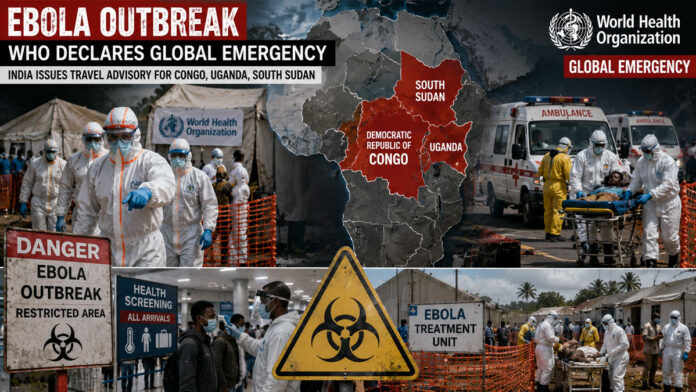
Ebola Outbreak concerns have intensified globally after the World Health Organization (WHO) declared the ongoing Ebola virus spread in parts of Central Africa a Public Health Emergency of International Concern (PHEIC) under the International Health Regulations (IHR) 2005 framework.
The emergency declaration comes amid rising Ebola infections in the Democratic Republic of Congo and Uganda, with neighboring South Sudan also considered at high risk for possible disease transmission.
Following the WHO announcement, the Government of India issued a travel advisory urging Indian citizens to avoid all non-essential travel to Congo, Uganda, and South Sudan until further notice.
WHO Declares International Public Health Emergency
The World Health Organization officially declared the Ebola outbreak a global public health emergency on May 17 due to the increasing spread of infections linked to the Bundibugyo strain of the Ebola virus.
According to a press release issued by India’s Ministry of Health and Family Welfare, the Africa Centres for Disease Control and Prevention (Africa CDC) has also classified the ongoing outbreak as a “Public Health Emergency of Continental Security.”
Health experts say the Bundibugyo strain of Ebola virus disease is a severe viral hemorrhagic fever with a high fatality rate. Officials noted that there are currently no approved vaccines or specific antiviral treatments available for this particular strain.
The WHO’s International Health Regulations Emergency Committee later issued temporary recommendations on May 22 aimed at strengthening disease surveillance and international response efforts.
WHO Issues Temporary Recommendations
Under the new WHO recommendations, countries have been advised to intensify screening and monitoring of travelers arriving from regions where the Bundibugyo virus has been detected.
The recommendations include identifying, evaluating, reporting, and managing travelers showing unexplained fever symptoms who may have recently visited affected regions.
The WHO has also advised against unnecessary travel to Ebola-affected zones to reduce the risk of cross-border transmission.
Countries bordering the Democratic Republic of Congo and Uganda, including South Sudan, are currently considered high-risk areas because of increasing regional movement and potential disease spread.
India Advises Citizens to Avoid Non-Essential Travel
In response to the growing international concern, India’s Ministry of Health and Family Welfare stated that no Ebola cases linked to the Bundibugyo strain have been detected in India so far.
However, considering the evolving situation in Africa and in line with WHO recommendations, Indian authorities have issued a precautionary advisory asking citizens to avoid non-essential travel to Congo, Uganda, and South Sudan.
Indian nationals currently residing in or traveling through these countries have been urged to strictly follow local public health guidelines and exercise extreme caution.
Health officials are also expected to strengthen surveillance systems and health screening protocols at airports and international entry points to minimize any potential risk of imported infections.
Ebola Remains One of the World’s Deadliest Viruses
Ebola virus disease remains one of the most dangerous infectious diseases globally due to its rapid transmission through direct contact with infected bodily fluids and its high mortality rate.
Symptoms typically include fever, severe weakness, vomiting, diarrhea, internal bleeding, and organ complications in severe cases.
Previous Ebola outbreaks in Africa triggered major international health emergencies, prompting large-scale quarantine operations, border screening measures, and emergency medical interventions.
Global health agencies are now closely monitoring the latest outbreak as international efforts continue to contain the spread and prevent wider transmission beyond affected regions.
Authorities worldwide are urging travelers to remain informed, follow official advisories, and report any symptoms immediately if exposed to high-risk areas.